Walking down into your basement and spotting a horizontal crack running across your concrete block wall—or realizing the wall itself is leaning inward—is a stressful discovery for any homeowner. Across Pittsburgh and Western Pennsylvania, bowing foundation walls are one of the most common structural issues we encounter. Fortunately, catching inward wall movement early means you rarely have to tear out and rebuild your foundation. Instead, modern structural reinforcement methods like carbon fiber straps and steel wall anchors can permanently stabilize your home.
Understanding how these two systems work—and which one fits your basement’s exact condition—will help you make a confident, cost-effective decision before seasonal soil pressure worsens the damage.
Why Pittsburgh’s Hillsides and Clay Soils Push Basement Walls Inward
Pittsburgh’s dramatic topography and soil composition put unique stress on residential foundations. Many homes in Allegheny and Westmoreland counties are built into steep hillsides or surrounded by heavy, clay-rich “Pittsburgh red-bed” soil. Unlike sandy soil that drains quickly, clay acts like a sponge—absorbing heavy spring rains and melting snow, expanding significantly, and pressing tightly against your exterior foundation walls.
When winter freeze-thaw cycles cause that saturated soil to expand and contract repeatedly, the resulting lateral hydrostatic pressure pushes against hollow cinder-block or older masonry walls. Because concrete and mortar are strong under vertical compression (holding up the weight of your house) but weak against sideways pressure, the wall eventually cracks horizontally along the middle mortar joints and begins bowing inward.
How to Measure Inward Wall Deflection Before Calling a Contractor
Before comparing repair methods, structural specialists measure how far your wall has shifted out of plumb—a measurement known as inward deflection. You can get a rough idea at home by holding a long, straight 4-foot level vertically against the middle of the wall or dropping a plumb line from the top sill plate down toward the floor: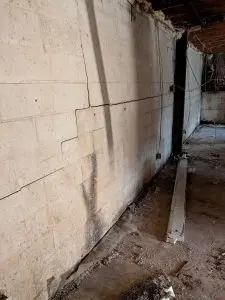
- Less than 2 inches of inward bow: The wall is typically an ideal candidate for non-invasive interior carbon fiber reinforcement.
- More than 2 inches of inward bow or shearing at the base: The wall has moved past the threshold where surface straps alone are recommended and generally requires heavy-duty mechanical steel wall anchors or structural steel I-beams.
Option 1: Aerospace-Grade Carbon Fiber Reinforcement Straps
Carbon fiber wall reinforcement has become the preferred solution for mild-to-moderate bowing walls in Pittsburgh homes. Originally engineered for aerospace and bridge construction, unidirectional carbon fiber strips boast a tensile strength several times greater than structural steel while remaining completely flat against your wall.
How Industrial Epoxy Bonding Locks Masonry in Place
During installation, a technician grinds away paint or surface coatings along vertical strips spaced roughly every four feet across the affected wall. High-strength structural epoxy is applied to the masonry and the carbon fiber straps, bonding the material directly into the concrete blocks. Once cured, the straps are anchored at the top sill plate and bottom footing, turning a fractured wall into a rigid, unified structural system that cannot bow any further.
Ideal Conditions and Aesthetic Benefits
Because carbon fiber straps sit less than one-eighth of an inch thick against the wall, they take up zero floor space. Once the epoxy cures, you can paint right over the straps or frame a finished basement wall directly in front of them. Better yet, installation is completed entirely from inside your basement—usually in a single day—without digging up decks, concrete patios, landscaping, or narrow Pittsburgh side yards.
Option 2: Heavy-Duty Galvanized Steel Wall Anchors
When lateral soil pressure has pushed a basement wall inward by more than two inches, or when the wall is actively tipping, galvanized steel wall anchors provide the mechanical leverage needed to hold—and potentially straighten—the structure.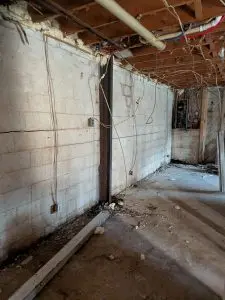
Anchoring Into Undisturbed Soil Beyond Your Foundation
Steel wall anchor systems connect your interior basement wall to stable, undisturbed earth 10 to 12 feet out in your yard. Technicians auger a small hole through the basement wall, drive a high-strength galvanized steel rod outward to a buried earth anchor plate, and secure a heavy-duty steel wall plate on the inside of your basement.
When Wall Anchors Are Necessary Over Carbon Fiber
Unlike carbon fiber straps, which freeze a wall permanently in its current position, steel wall anchors can be tightened over time. During dry summer months when surrounding soil shrinks back, technicians can gradually torque the interior anchor nuts to pull the bowing wall closer to its original vertical alignment. However, wall anchors require accessible exterior yard space—meaning they may not be feasible if a concrete driveway, neighboring house, or sunroom sits immediately outside the damaged wall.
Frequently Asked Questions About Bowing Wall Stabilization
Can carbon fiber straps straighten a bowed basement wall back to vertical?
No. Carbon fiber straps are engineered to permanently lock a bowing wall in place so it can never shift inward again. If your wall has bowed more than two inches and requires gradual straightening, steel wall anchors or steel bracing systems are the recommended approach.
How many carbon fiber straps does a typical basement wall need?
Most residential foundation walls require carbon fiber straps spaced every four feet along the entire length of the bowing section. Proper installation also requires tying the straps into both the upper floor framing and the lower footing to distribute soil pressure evenly.
Does bowing wall repair require excavating my Pittsburgh yard or porch?
Not when carbon fiber straps are used. Because carbon fiber reinforcement is installed 100% from inside your basement, your porch, patio, walkways, and landscaping remain completely undisturbed.
Get a Family-Owned Structural Evaluation in Pittsburgh
A bowing basement wall will never fix itself—and waiting through another Western Pennsylvania freeze-thaw winter only increases the risk of severe structural failure. With more than 21 years of experience serving Pittsburgh, Pitcairn, and surrounding Allegheny County communities, ARK Basement Services provides honest, thorough foundation assessments backed by written warranties on every job.
Call our Pittsburgh office today at (412) 896-7447 or request your FREE, no-obligation estimate online. Be sure to ask about our senior and military discounts, referral programs, and convenient financing options through Dollar Bank and Synchrony.

Mike Perry is the esteemed owner of ARK Basement Services, a premier company specializing in basement waterproofing and foundation repair services. Under Mike’s leadership, ARK Basement Services has established itself as a trusted leader in the industry, known for delivering high-quality, reliable solutions to homeowners facing basement and foundation issues. Mike’s commitment to excellence, combined with his extensive knowledge and experience in the field, has been instrumental in building a company that is dedicated to ensuring customer satisfaction and the longevity of their homes. His hands-on approach and dedication to utilizing the latest technologies and methods have set ARK Basement Services apart, making them a go-to provider for those in need of expert basement and foundation services. For more details on Mike Perry’s work and ARK Basement Services, visit their website at https://www.arkbasementservices.com/.